I Tried Casting a Hand with Plaster of Paris and Ceramic Resin. Here’s What Happened.
Sometimes art projects go exactly as planned. This wasn’t one of those times. 😂
After seeing a video where someone made a hand using a latex glove, I figured it looked easy enough. Looking back, I’m pretty sure they used cement, because my experience with Plaster of Paris was…well…a little different.
Attempt #1: Plaster of Paris
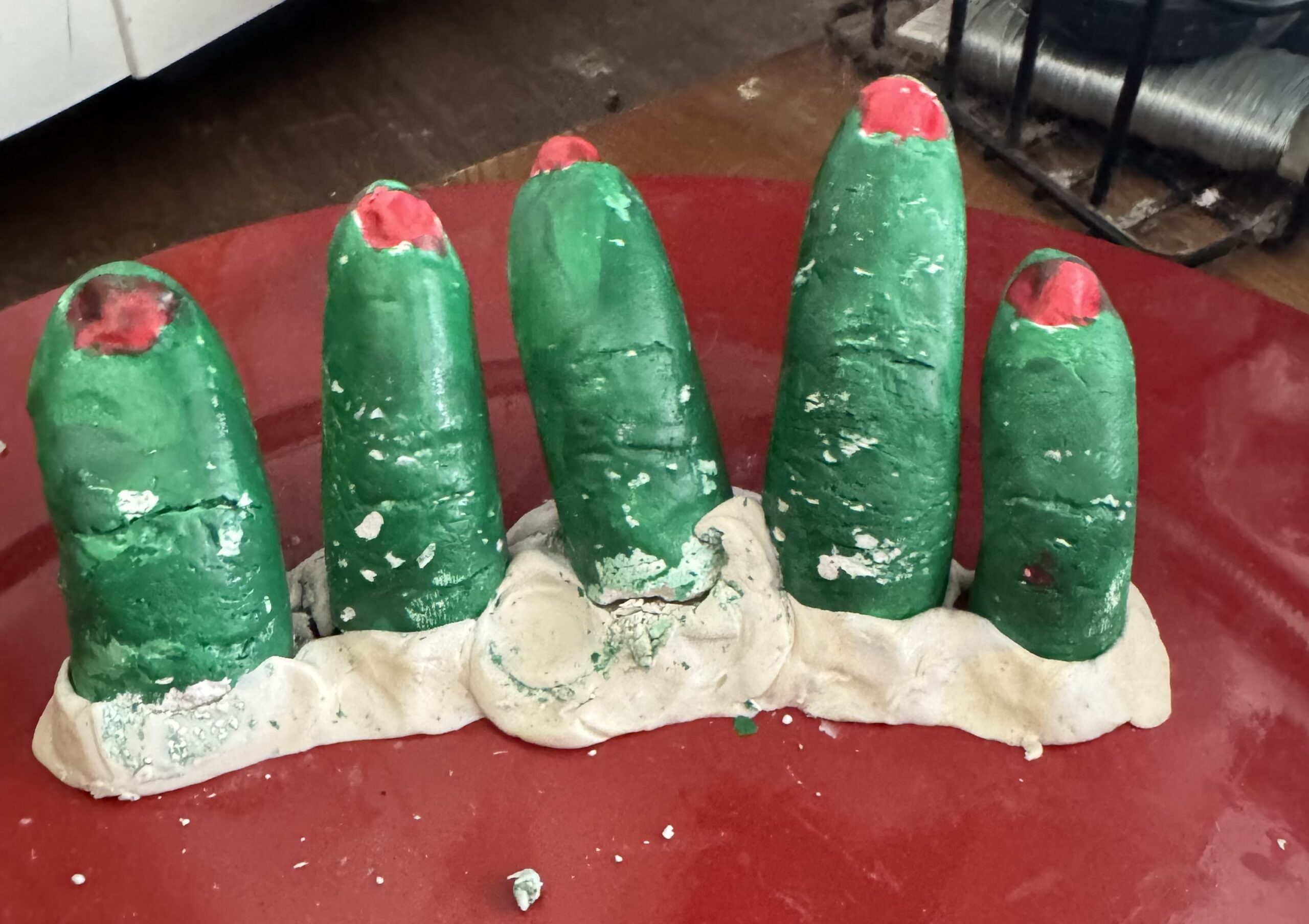
I started by mixing Plaster of Paris to fill a latex glove. The mixing process was very easy. After filling the gloves, I started to maniuplate it so try to form the fingers while it was still moldable. I let them harden before cutting away the latex.
At first, I was excited because the fingers actually looked pretty good. Unfortunately, de-gloving was another story. One finger broke. Then another. By the time I finished removing the glove, none of the fingers survived attached to the hand. 😂
The fingers themselves looked really good. They even captured some of the wrinkles from the latex glove. The hand, however, wasn’t my favorite. The palm ended up looking too flat and square instead of looking like a relaxed human hand.
The good news? I now have a collection of creepy severed fingers that I attempted to use, but the material I had I hand to use them with sucked and it did not work out. So that went to the trash.
Transporting the Fingers
I did this project at my mom’s house with her. Her fingers all broke as well. But her’s broke into several peices. Since the fingers were so fragile, I needed a way to get them home safely. A bucket of rice turned out to be the perfect packing material. It supported the fingers from every direction without putting pressure on them, so they survived the trip much better than I expected.
Attempt #2: Ceramic Resin Mix
Not ready to give up, I picked up a ceramic resin mix for another glove casting attempt.
This time my biggest problem wasn’t the material. It was me. I followed the instructions printed on the outside of the bag and completely missed the instruction sheet that was tucked inside. 🤦♂️ Because of that, I mixed it way too watery.
I was not sure but was pleased that it still cured.
I tried shaping and moving the fingers before everything had fully cured. That introduced air bubbles, separated the material, and you guessed it broke the fingers again.
What I Learned
After trying two different casting materials, I don’t actually think the material is the biggest issue. I think it’s the glove. Even if everything had gone perfectly, I still don’t like how the palm looks. Latex gloves naturally flatten out, so the finished hand ends up looking boxy instead of having the curves and natural shape of a real hand.
The fingers? I actually love them. The palm? Not so much.
What’s Next?
Instead of trying another latex glove, I’m going to look into creating an actual hand mold. I think making a proper mold will produce a much more natural-looking hand and allow me to test different casting materials without fighting against the shape of the glove itself.
Final Thoughts
Not every art challenge ends with a masterpiece, and honestly, that’s okay. Sometimes the fun is figuring out what doesn’t work.
I learned that Plaster of Paris captures nice detail but is incredibly fragile for thin pieces like fingers. I learned that reading all the instructions matters, especially the ones hiding inside the bag. And I learned that while the glove technique looks simple in videos, it isn’t the right method for the kind of realistic hand I’m hoping to create.
Will I try again? Absolutely. Just not with a latex glove. 😄